
September in Guangzhou hasn’t cooled down at all. On the weekend a week after registration, I took my seat in a classroom again. As an MEM student with several years of engineering and project experience, I came in expecting to “fill gaps in management knowledge, learn hard methods, widen my career boundaries.” I pictured Engineering Systems Decision & Optimization as blackboards full of formulas, endless operations-research problem sets, a thick textbook, and the few pages the professor tells you to memorize before the exam.
After one class, I realized: this course isn’t about solving problems on paper. It’s about how to make a genuinely good decision in a world where information is always incomplete and outcomes are never certain.
1. A Decision Is Not Its Outcome
The first thing that overturned my thinking was the most basic idea — and the one working professionals overlook most easily: a decision is not the same thing as its outcome.
Professor Zhai opened with a question: a sober driver who gets into an accident, versus a drunk driver who makes it home safely — which one made the good decision?
In the work contexts I’m used to, we judge heroes by results. If the project succeeds, the call was brilliant. If it fails, the judgment was flawed. But the course is unambiguous: the quality of a decision and the quality of its outcome are two different things. A good decision can still produce a bad outcome through bad luck, and a bad decision can stumble into a good ending.
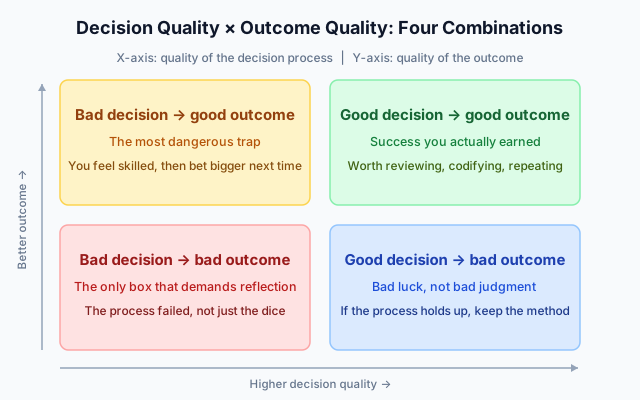
Among the four combinations, the dangerous one is that yellow box — a bad decision meeting a good outcome. It convinces you that you’re highly capable, and then you bet far more on the next round.
One line from the lecture stuck with me: once you truly internalize the difference between decisions and outcomes, you’re free of two useless emotions — regret and worry. If the decision was sound, don’t regret a bad outcome. And the anxiety you feel before deciding is better converted into the work of making the decision process solid. That line landed squarely on a confusion I’ve carried for years.
2. Decisions Can Be Decomposed and Calculated
The second shift was realizing that decisions can be systematically decomposed and calculated — not left entirely to experience, intuition, and a call from the top.
I used to think decision-making meant: hold a meeting, argue it out, make the call, own the consequences. This course breaks it into an actionable method: how to define the problem, how to build the decision frame, how to generate alternatives, how to express uncertainty as probability, how to compute expected utility, and how to judge whether a piece of information is worth paying for.
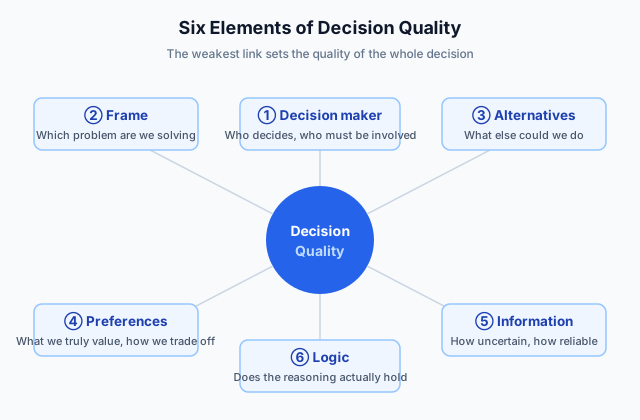
The six elements of decision quality — decision maker, frame, alternatives, preferences, information, logic — turn the fuzzy act of “making the call” into a list you can check one item at a time. Whichever element collapses takes the quality of the whole decision with it.
The exercise that stayed with me was the thumbtack-and-coin experiment. Given an asymmetric thumbtack, everyone’s intuition says the fair coin is the safer bet — but the math shows that no matter which side the tack favors, if you always guess in correspondence with the coin’s result, your win rate is exactly 50%. And the classic oil-drilling problem: whether to drill, whether to spend $30,000 on a seismic survey — all of it can be worked out cleanly with decision trees and Bayesian probability.
In engineering we often joke about “going with the gut.” Having taken this class, I now know how much of that gut territory is actually computable.
3. Sunk Cost and the Value of Insight
The two most immediately useful concepts were sunk cost and the value of information.
On past projects I would get stuck in the grip of “we’ve invested this much, stopping now wastes all of it” — and sink deeper. Now I understand: what’s past is sunk. A decision looks only at future costs and future benefits.
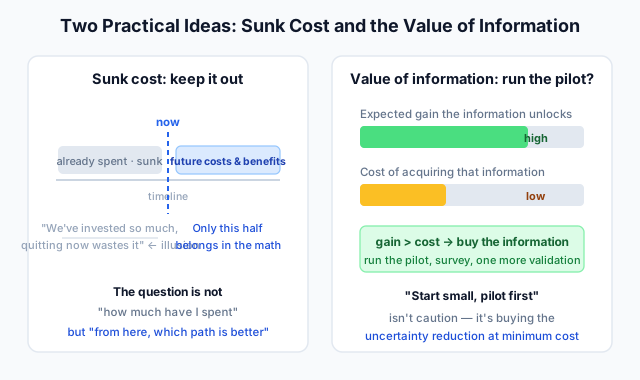
And the whole family of questions — should we run a pilot, commission a study, do one more round of validation — is fundamentally about computing the value of information. If what you buy with that spend raises the decision’s expected payoff by more than it costs, it’s worth it.
“Start small, pilot first” — I used to know only that it was the prudent approach. Now I understand the logic underneath: spend the minimum to acquire the information that matters, reduce the uncertainty, and only then decide whether to roll out fully. That isn’t conservatism. It’s the most scientific strategy available.
4. Beneath Method Lies the Frame
The buggy-whip and Polaroid cases hit hard.
As sales declined, the buggy whip makers drove costs down and efficiency up, optimizing their process to something close to flawless — while missing that the automobile age had arrived and their entire industry was disappearing. Polaroid won its patent war against Kodak and held its instant-photography monopoly — while missing the digital wave.
Both executed correctly. Both had framed the wrong problem.
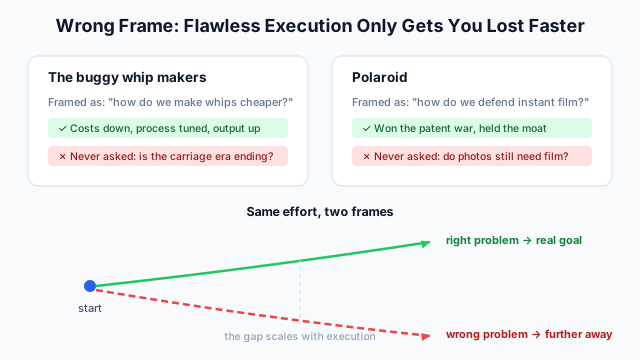
For someone with an engineering background, that’s a warning. We’re very good at solving problems, and we routinely skip the step of confirming whether this is the right problem. Pick the wrong frame, and the harder you work, the further you get from the goal that actually matters.
5. After the First Class
The first course of the semester gave this returning professional a vivid lesson.
MEM, it turns out, doesn’t just teach management methods and engineering technique. It teaches a foundational framework for thinking. The world we live in is permanently uncertain: nothing at work comes with complete confidence, and life is full of dilemmas with no clean answer. What this course teaches is how to still produce a high-quality decision when the information is incomplete and the outcome is unknowable.
Not gambling on luck. Not running on intuition. Relying on frames, on logic, on scientific method.
That, I think, is the most valuable thing I’ve taken from MEM so far.